Page 3 of 7
Re: Crusted port database
Posted: 20:05 Wed 06 Oct 2010
by SushiNorth
Dom Symington wrote:Crusted has never included the vintage (year of vinification) but only the bottling year. If a vintage (year of vinification) is included on the label plus a bottling year it will effectivly be an LBV or non-declared vintage port.
This would suggest that the real value in all this data is to create a list of non-declared VPs, which in itself might make for an interesting tasting.
Re: Crusted port database
Posted: 20:43 Wed 06 Oct 2010
by jdaw1
Dominic: My understanding, perhaps wrong, is that VP is aged in giant Tonnels for not more than two-ish years. From there it can go directly into bottle, or, ≤1970 vintage, into a much smaller shipper’s pipe for transport to, and subsequent bottling in, the UK. LBV used to be late-in-the-UK, meaning two in Tonnel, more in shipper’s pipe, then into bottle. Was it always true that Crusted/ing never spent more than a couple of years in Tonnel? If so, it really was an LBV. But if Crusted/ing sometimes aged awhile in Tonnels, then, at least up to 1970, it was fundamentally different to LBV.
Re: Crusted port database
Posted: 17:00 Thu 07 Oct 2010
by uncle tom
Dom,
In compiling this database, I have worked on the principle that if the label says Crusted, then Crusted it is. With the older bottles, and catalogue entries, it is often hard to determine if the content is Crusted as we know it today, or an ancestor of LBV or SQVP.
But while we have your attention on the subject, how about bottling a second wine from Vesuvio each year, and marketing that as a Crusted port?
- Just an idea!
Tom
Re: Crusted port database
Posted: 19:11 Thu 07 Oct 2010
by Dom Symington
well that certainly woke everyone up!
Tom, very fair comment although I'm not sure I'll bring up your second point at tomorrow's Board Meeting!
Julian, generally correct although the bottling was very much a question of merchants choice (and conviction in some cases). There was no firm rule as to the age of the blend for Crusted/ing. The difference also one would assume is that ...ed was pre-aged by the wine merchant and that ...ing was sold on bottling for further ageing!
Just back from a day at Vesuvio, Vintage in the last stretch although the weather certainly looks like it may take a turn for the worse ... we still have 5 or so days to go. Fingers crossed!
Re: Crusted port database
Posted: 08:45 Fri 08 Oct 2010
by DRT
Thanks for you recent activity here, Dom - very interesting! (although I am minded to think that part of your motivation is to see what comes next in the ranks after "cheap ruby"

)
Good luck with the last stretch of the harvest.
Given the discussion above I think we need some facts around which to frame the definitions. I will trawl through my books later to see when the various styles were defined. I will then take some mind-bending drugs and read Julian's last post again to attempt to understand what he is trying to say
Re: Crusted port database
Posted: 12:04 Fri 08 Oct 2010
by jdaw1
DRT wrote:and read Julian's last post again to attempt to understand what he is trying to say
At least at the start of LBV, it spent two years in Tonnels, and was then shipped to the UK in shipper’s pipe. So, if a style of port let’s call it Crusted has two years in Tonnel and ages in shipper’s pipe, it’s just like an LBV. But if this mysterious ‘Crusted’ stuff spends ages and ages in Tonnel, then it isn’t like an (early) LBV.
Re: Crusted port database
Posted: 12:57 Fri 08 Oct 2010
by uncle tom
The difference also one would assume is that ...ed was pre-aged by the wine merchant and that ...ing was sold on bottling for further ageing!
This raises the interesting question as to whether Crust
ing port (as Dom defines) could be legally sold today?
Battling through the Portuguese of the IVDP regulations, I can only find reference to the word Crust
ed so presumably Crust
ing is an unregulated term.
And although it rarely appears, there does not seem to be anything to stop a producer putting the bottling date on a Reserve.
So could we have, for example,
'TPF Crusting Port' (writ large on the label)
'Bottled in 2010' (writ only slightly smaller) and then
'A blend of unfiltered fine reserve ports, supplied by Symington family estates...etc' (in small print at the bottom) ?
If booked out as a Reserve, it could presumably be shipped immediately.
- or have I missed something?
Tom
Re: Crusted port database
Posted: 13:15 Fri 08 Oct 2010
by DRT
jdaw1 wrote:DRT wrote:and read Julian's last post again to attempt to understand what he is trying to say
At least at the start of LBV, it spent two years in Tonnels, and was then shipped to the UK in shipper’s pipe. So, if a style of port let’s call it Crusted has two years in Tonnel and ages in shipper’s pipe, it’s just like an LBV. But if this mysterious ‘Crusted’ stuff spends ages and ages in Tonnel, then it isn’t like an (early) LBV.
Ah, so you are attributing the difference to the size of the wooden cask in which the port is aged prior to bottling. I may be wrong but I don't think that is relevant. The thing that would make the difference in "style" (in an official sense) is the length of time in wood, not the size of the cask.
I am sure there are some small producers out there who make their LBV in small vats or pipes simply because they only make small quantities. Some of the big boys might bottle straight from the Tonnel whilst others might give their wines some time in smaller casks to speed-up the evolution process so that their LBV's are ready to drink as soon as they are bottled. None of this would bar them from classifying the wine as LBV.
Am I missing something?
Re: Crusted port database
Posted: 15:51 Fri 08 Oct 2010
by g-man
DRT wrote:jdaw1 wrote:DRT wrote:and read Julian's last post again to attempt to understand what he is trying to say
At least at the start of LBV, it spent two years in Tonnels, and was then shipped to the UK in shipper’s pipe. So, if a style of port let’s call it Crusted has two years in Tonnel and ages in shipper’s pipe, it’s just like an LBV. But if this mysterious ‘Crusted’ stuff spends ages and ages in Tonnel, then it isn’t like an (early) LBV.
Ah, so you are attributing the difference to the size of the wooden cask in which the port is aged prior to bottling. I may be wrong but I don't think that is relevant. The thing that would make the difference in "style" (in an official sense) is the length of time in wood, not the size of the cask.
I am sure there are some small producers out there who make their LBV in small vats or pipes simply because they only make small quantities. Some of the big boys might bottle straight from the Tonnel whilst others might give their wines some time in smaller casks to speed-up the evolution process so that their LBV's are ready to drink as soon as they are bottled. None of this would bar them from classifying the wine as LBV.
Am I missing something?
Are ports stored in neutral or toasted barrels?
the smaller the barrel, the more the toast of the barrel will impart flavors upon the smaller liquid volume no?
I would imagine the surface area of a smaller barrel to liquid ratio of a small barrel is greater then the same ratio on a bigger barrel. Probably giving a more vanilla/oak if barrels were even lightly toasted before bottling.
Re: Crusted port database
Posted: 16:35 Fri 08 Oct 2010
by DRT
g-man wrote:Are ports stored in neutral or toasted barrels?
Neutral.
The difference between large and small casks for port is the speed of oxidation. The larger the cask the slower the oxidation.
Re: Crusted port database
Posted: 17:21 Fri 08 Oct 2010
by g-man
DRT wrote:g-man wrote:Are ports stored in neutral or toasted barrels?
Neutral.
The difference between large and small casks for port is the speed of oxidation. The larger the cask the slower the oxidation.
i wonder if individuals can buy these after aged barrels =)
I've got a 30lb pig I'm looking to smoke!
Re: Crusted port database
Posted: 17:39 Fri 08 Oct 2010
by Dom Symington
Derek, you are partly right ...!
Crusted is now the only permitted version and the wines are certified on bottling, must be cellared for a minimum of 3 years before release and undergo a second certifictaion from the IVDP prior to final release to market.
The "toast" on port barrels is a red-herring, all port is always aged in seasoned tonnels or pipes, never new wood. The only "toast" they get is when being made in the cooperage when water and a brazier are used to bend the staves and is frankly not significant. I can see that on your next visit we'll have to spend some time in the cooperage!
Julian, although broadly right I don't think you should get too fixed on 2 years in tonnels etc... This time scale only came into formal use recently. In the past, the age prior to bottling and shipment was up to each individual, and considering that until the demise of bulk shipments Crusted/Crusting wasn't even recognised by the IVP (at the time with no D!). We used to ship "Crusted" for UK bottling as a Reserve.
In all these permutations the secret is for the blend to have the ability to throw a crust and therefore evolve in bottle. The longer in cask (of any size - faster ageing if smaller/slower if larger) the softer the wine will become irrespective of its ability to throw a crust.
Re: Crusted port database
Posted: 18:51 Fri 08 Oct 2010
by uncle tom
Dom,
Do you think the IVDP would take issue with the use of the word Crusting as part of the brand name for an unfiltered Reserve?
Tom
Re: Crusted port database
Posted: 19:46 Fri 08 Oct 2010
by Dom Symington
Tom. I have absolutely no doubt that they would! We live in an extrodinarily regulated environment which unfortunately has very little imagination or simple marketing experience and believes that restriction is the best solution! ... aka, despite what some of the worthy members of this forum may feel (with due apologies!), Pink was case in example!
Re: Crusted port database
Posted: 21:15 Fri 08 Oct 2010
by uncle tom
Dom,
Thanks - I was actually quite surprised that Pink was allowed, as it seemed to denigrate the product class as a whole; and while some producers have now managed to produce an acceptable Rose port, the earliest samples were truly awful. Although the word offers an alliteration, I still think that 'Pink' is an inappropriate descriptor for a product class that has a hard fought reputation for quality and distinction.
Moving on, I do have a serious interest in procuring products that have an appeal to niche markets. Even if Crusting is too close to Crusted to place it off-limits on the label, I am still interested in routinely buying a quality, unfiltered and ageworthy Reserve that has the year of bottling clearly indicated on the label. Quantities would not be huge, but commerically viable. If you are interested, please ask your marketing guys to contact me privately.
Tom
Re: Crusted port database
Posted: 22:57 Fri 19 Nov 2010
by jdaw1
From the 1966/7 price list of Henekeys and Backs of Norwich
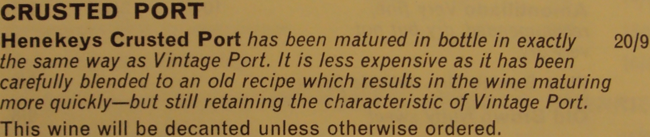
I know that there is no bottling date you can see what I can see.
Re: Crusted port database
Posted: 15:20 Sun 21 Nov 2010
by jdaw1
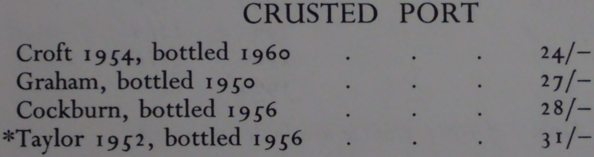
Winter 1965/1966, from Edwin Giddings Ltd, then of 28 St John Street, Devizes, now of 15 St John Street

Re: Crusted port database
Posted: 15:21 Sun 21 Nov 2010
by jdaw1
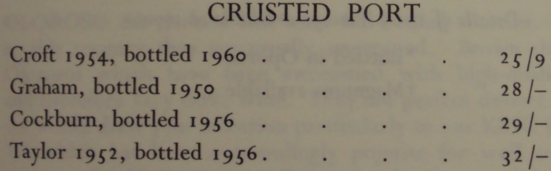
Winter 1966/1967, from Edwin Giddings Ltd, then of 28 St John Street, Devizes, now of 15 St John Street
Re: Crusted port database
Posted: 21:11 Sun 21 Nov 2010
by jdaw1
! of which the Graham 1950 and Taylor 1952/56 are not currently in the list.
Re: Crusted port database
Posted: 23:16 Sun 21 Nov 2010
by jdaw1
Dolamore Wine List Summer 1973


Prices are per £ bottle for: six cases; one case; a single bottle.
Re: Crusted port database
Posted: 23:33 Sun 21 Nov 2010
by jdaw1
Dolamore Wine List Autumn 1973

Prices are £ per bottle for: six cases; one case; a single bottle.
Re: Crusted port database
Posted: 23:40 Sun 21 Nov 2010
by jdaw1
Dolamore Wine List Summer 1974

Prices are £ per bottle for: six cases; one case; a single bottle.
Re: Crusted port database
Posted: 23:44 Sun 21 Nov 2010
by jdaw1
Dolamore Wine List Summer 1975
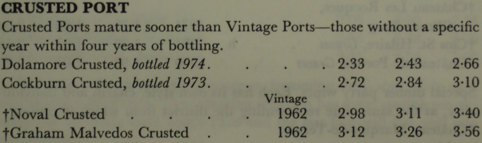
Prices are £ per bottle for: six cases; one case; a single bottle.
Re: Crusted port database
Posted: 23:50 Sun 21 Nov 2010
by jdaw1
Dolamore Abridged Spring List 1977

Prices are £ per case for: ‟12 Cases Assorted”; ‟6 Cases Assorted”; ‟One Case”.
Re: Crusted port database
Posted: 00:02 Mon 22 Nov 2010
by jdaw1
Dolamore Abridged Winter Wine List 1978-79 Wholesale
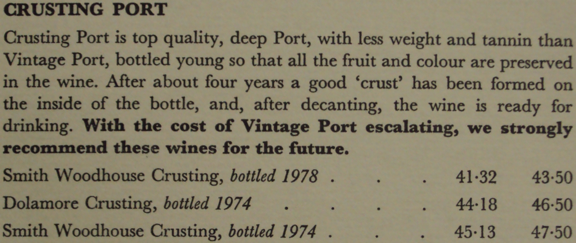
Prices are £ per case for: ‟7 Cases Assorted”; ‟One Case”.
Re: Crusted port database
Posted: 00:05 Mon 22 Nov 2010
by jdaw1
Dolamore, September 1981

Prices are £ per case and per bottle.
Re: Crusted port database
Posted: 00:08 Mon 22 Nov 2010
by jdaw1
Dolamore, October 1982

Prices are £ per case and per bottle.
Re: Crusted port database
Posted: 08:16 Mon 22 Nov 2010
by JacobH
jdaw1 wrote:Winter 1966/1967, from Edwin Giddings Ltd, then of 28 St John Street, Devizes, now of 15 St John Street
Are the Croft and Taylor more likely to be LBVs rather than Crusteds? I can't think of another explanation for two dates on the bottle.
Re: Crusted port database
Posted: 18:33 Mon 22 Nov 2010
by DRT
JacobH wrote:jdaw1 wrote:Winter 1966/1967, from Edwin Giddings Ltd, then of 28 St John Street, Devizes, now of 15 St John Street
Are the Croft and Taylor more likely to be LBVs rather than Crusteds? I can't think of another explanation for two dates on the bottle.
No, no, no. How could they possibly be LBV when it wasn't "invented" until Noval released their 1958 and then "invented" again by Taylor when the released their 1965? Not wishing to single out these two houses, there seems to have been lots of others who "invented" LBV at various times
I agree, these are LBVs. But the term wasn't in common useage at the time so it probably made more sense to describe them as Crusted.
Re: Crusted port database
Posted: 20:26 Mon 22 Nov 2010
by JacobH
DRT wrote:JacobH wrote:Are the Croft and Taylor more likely to be LBVs rather than Crusteds? I can't think of another explanation for two dates on the bottle.
No, no, no. How could they possibly be LBV when it wasn't "invented" until Noval released their 1958 and then "invented" again by Taylor when the released their 1965? Not wishing to single out these two houses, there seems to have been lots of others who "invented" LBV at various times
I agree, these are LBVs. But the term wasn't in common useage at the time so it probably made more sense to describe them as Crusted.
These comments beg another question: when was the expression ‟late bottled vintage” first used? Doing a quick search of the Usual Free Sources, I can’t find any mention before André Simon’s
Vintagewise where he comments (in 1945):
‟A rather unusual and very agreeable recollection which I also treasure is that of a bottle of Graham 1878, bottled in 1882, which Ian Campbell gave us at his office one hot August day, in 1929; the occasion was the anniversary of his wedding day, and although we rather wished he had chosen the winter to get married, this charming late-bottled vintage Port managed to beat the weather.” [thanks to jdaw1 for the transcription]
The next mention is in his 1946
Wine Primer where it has lost the hyphen (which, thinking about, we really ought to campaign to have restored). I can’t find any other pre-1950 use of the expression.
Re: Crusted port database
Posted: 21:16 Mon 22 Nov 2010
by jdaw1
Balls Brothers of London, Wine List Summer ’82.

Re: Crusted port database
Posted: 21:21 Mon 22 Nov 2010
by jdaw1
David Baillie Vintners, at the Sign of the Lucky Horseshoe, 86 Longbrook Street, Exeter, Devonshire
Summer 1986

Re: Crusted port database
Posted: 22:11 Mon 22 Nov 2010
by jdaw1
Peter Bedford Limited, Wine & Cigar Merchant, Leamington Spa and Warwick, 1967/8.

Re: Crusted port database
Posted: 22:25 Mon 22 Nov 2010
by jdaw1
Bentalls, October 1975

Re: Crusted port database
Posted: 23:24 Mon 22 Nov 2010
by jdaw1
The Butlers Wine Cellar, Brighton, Christmas 1989


Re: Crusted port database
Posted: 21:38 Tue 23 Nov 2010
by jdaw1
The 1994 Davisons Wine Collection
Price List Summer 1994

Prices per single bottle, and per bottle in a mixed case.
There are no Gould Campbells on the list.
Re: Crusted port database
Posted: 22:02 Tue 23 Nov 2010
by jdaw1
The Fulham Road Wine Centre, in an undated wine list giving a phone number beginning 071 (implying not much before 06 May 1990) and containing one wine of vintage 1990 (suggesting ≈1991).

Re: Crusted port database
Posted: 16:01 Wed 24 Nov 2010
by uncle tom
These comments beg another question: when was the expression ‟late bottled vintage” first used?
Without wishing to get into a debate over semantics, I think one needs to draw a distinction between a vintage port that happened to be bottled late, and a port that was deliberately marketed as Late Bottled Vintage.
The test, I would suggest, is the use of the term in a merchant's catalogue, and as far as I know, the Wine Society holds the distinction of using the term first in 1964 for a Fonseca Q. Mileu 1958, also bottled in 1964.
Tom
PS: List now updated.
Re: Crusted port database
Posted: 18:26 Wed 24 Nov 2010
by jdaw1
Hurlingham Vintners, undated list of about the late 1970s.

Re: Crusted port database
Posted: 19:24 Wed 24 Nov 2010
by DRT
uncle tom wrote:The test, I would suggest, is the use of the term in a merchant's catalogue, and as far as I know, the Wine Society holds the distinction of using the term first in 1964 for a Fonseca Q. Mileu 1958, also bottled in 1964.
That's not a bad test to apply, Tom, and Julian and I are on the lookout for other examples. Something I think is worth adding to the criteria as being what we now term LBV is that the wine should have been Oporto bottled - i.e. designed and produced as LBV by the shipper, not turned into LBV by a merchant.
Re: Crusted port database
Posted: 20:58 Wed 24 Nov 2010
by uncle tom
Something I think is worth adding to the criteria as being what we now term LBV is that the wine should have been Oporto bottled
I can see your reasoning; but if the Mileu '58 (which was English bottled) was shipped shortly before bottling, and had not languished, forgotton, in the WS's warehouse for a few years (thereby making the LB element merely expedient), I would suggest that it qualifies.
As the WS appears to have good archives; perhaps the purchase date of that consignment can be established.
Tom
Re: Crusted port database
Posted: 23:01 Wed 24 Nov 2010
by JacobH
uncle tom wrote:Without wishing to get into a debate over semantics, I think one needs to draw a distinction between a vintage port that happened to be bottled late, and a port that was deliberately marketed as Late Bottled Vintage.
The test, I would suggest, is the use of the term in a merchant's catalogue, and as far as I know, the Wine Society holds the distinction of using the term first in 1964 for a Fonseca Q. Mileu 1958, also bottled in 1964.
Oh, yes, indeed. What I was interested in was something slightly different; when was the phrase ‟late bottled vintage port” first coined, rather than when the product it describes came about. There is no particular reason why a vintage port bottled 4 years after a harvest should be called a ‟late bottled vintage” any more than it should be called ‟cellar reserve” or anything else; so someone must have coined the phrase at some stage, and I wonder if that was André Simon. For an interesting comparison, using the same free sources produces references to ‟crusted port” from as far back as 1799, but the earliest use of the expression ‟vintage port” seems to be from the 1850s...
Also, and changing subject, do you know anything else about Quinta Mileu (e.g. where is it and whether any other SQP has been made from it?).
Re: Crusted port database
Posted: 00:20 Thu 25 Nov 2010
by jdaw1
Christopher & Co. Ltd, Xmas 1930.
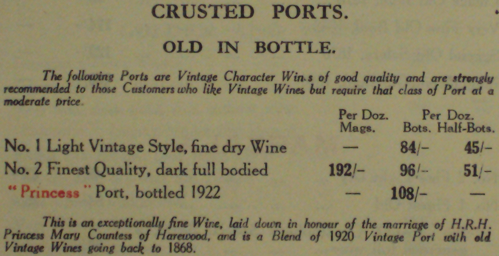
Re: Crusted port database
Posted: 00:25 Thu 25 Nov 2010
by jdaw1
Christopher & Co. Ltd, Xmas 1930.

Re: Crusted port database
Posted: 00:38 Thu 25 Nov 2010
by jdaw1
Christopher & Co. Ltd, Xmas 1960.

If this is vintage 1954 bottled ’56, that isn’t obviously late.
Re: Crusted port database
Posted: 00:49 Thu 25 Nov 2010
by jdaw1
Christopher & Co. Ltd, Autumn 1964.


Re: Crusted port database
Posted: 00:52 Thu 25 Nov 2010
by jdaw1
Christopher & Co. Ltd, Autumn 1965.


Re: Crusted port database
Posted: 00:53 Thu 25 Nov 2010
by jdaw1
Christopher & Co. Ltd, Autumn 1981.

Re: Crusted port database
Posted: 00:56 Thu 25 Nov 2010
by jdaw1
Christopher & Co. Ltd, Autumn 1981.

Re: Crusted port database
Posted: 00:58 Thu 25 Nov 2010
by jdaw1
Christopher & Co. Ltd, October 1984.