
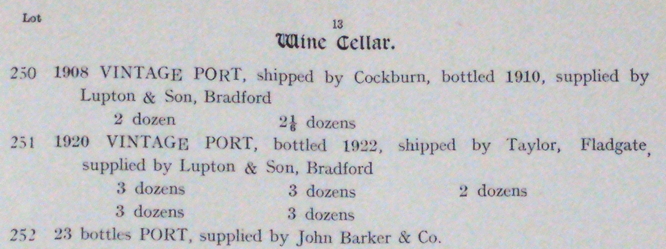
In lots 250 and 251, why is the quantity not shown whole? Why 2 dozen and 2â…™ dozens, rather than 4â…™ dozens? Why 3 and 3 and 2 and 3 and 3 dozens, rather than 14 dozens?
When hart davis does that with large lots.jdaw1 wrote:I’m puzzled by two lot descriptions from an auction held in Yorkshire in autumn 1924:
In lots 250 and 251, why is the quantity not shown whole? Why 2 dozen and 2â…™ dozens, rather than 4â…™ dozens? Why 3 and 3 and 2 and 3 and 3 dozens, rather than 14 dozens?
In which case the various conditions would be specified, which isn’t obviously happening here.g-man wrote:When hart davis does that with large lots.
it usually means that 1 portion of the lot is XXX condition while the other portion of the lot is in YYY condition.
If this was meant seriously, more information is needed.DRT wrote:A Dutch Auction?
My understanding of a Dutch Auction is that multiple identical or very similar lots are listed. The first of those is auctioned in the normal way, thus setting the price for that and all subsequent lots. The winner has the option of buying the first lot or as many of the lots as he/she wishes to buy at that price. If there are any left they are offered to the other bidders at the same price. I have no idea what happens if they are not all taken.jdaw1 wrote:If this was meant seriously, more information is needed.DRT wrote:A Dutch Auction?
jdaw1 wrote:You appear to be suggesting that these are really a sequence of lots, rather than being a single lot, with the usual time-saving ‘parcel’ convention. That makes sense.

That would also be my guess, though it makes less sense for lot 251 since the parcels aren't all similar in size. Another possibility is that the various lots came from different places and so are separated out for sale by source. Since there's no mention of condition I would expect them all to be the same (or very close) but I might still prefer to bid on one parcel over another based on its provenance, which might be too verbose to detail in that document.DRT wrote:A Dutch Auction?
I haven't checked, but I think jdaw1 will probably confirm that this was the auction of the contents of one house, these lots being from the "Wine Cellar". And each Lot is described as coming from one wine merchant.Glenn E. wrote:That would also be my guess, though it makes less sense for lot 251 since the parcels aren't all similar in size. Another possibility is that the various lots came from different places and so are separated out for sale by source. Since there's no mention of condition I would expect them all to be the same (or very close) but I might still prefer to bid on one parcel over another based on its provenance, which might be too verbose to detail in that document.DRT wrote:A Dutch Auction?
3 3 3 3 3 and 2 are similar. 3 3 3 3 and 45 would be not similar.Glenn E. wrote:That would also be my guess, though it makes less sense for lot 251 since the parcels aren't all similar in size.DRT wrote:A Dutch Auction?
2 and 2 1/6 are similar as there is only an 8% difference in the quantity of Port involved. If your glass contains 8% more Port than mine at a tasting, I might pout but I probably wouldn't make a fuss about it. There is even a chance that I wouldn't notice. Slim, but a chance nevertheless.DRT wrote:3 3 3 3 3 and 2 are similar. 3 3 3 3 and 45 would be not similar.Glenn E. wrote:That would also be my guess, though it makes less sense for lot 251 since the parcels aren't all similar in size.DRT wrote:A Dutch Auction?
I must disagree on the basis that 3 and 2, in an auction context, are almost exactly the same.Glenn E. wrote:2 and 2 1/6 are similar as there is only an 8% difference in the quantity of Port involved. If your glass contains 8% more Port than mine at a tasting, I might pout but I probably wouldn't make a fuss about it. There is even a chance that I wouldn't notice. Slim, but a chance nevertheless.DRT wrote:3 3 3 3 3 and 2 are similar. 3 3 3 3 and 45 would be not similar.Glenn E. wrote:That would also be my guess, though it makes less sense for lot 251 since the parcels aren't all similar in size.DRT wrote:A Dutch Auction?
3 3 3 3 3 2 are not similar as the 3's contain 50% more Port than the 2. If your glass contains 50% more Port than mine at a tasting, there will be a fuss.

Noted, perhaps greatly to my advantage.Glenn E. wrote:If your glass contains 8% more Port than mine at a tasting, I might pout but I probably wouldn't make a fuss about it. There is even a chance that I wouldn't notice.
Current draft of the text, the wording still needing a little re-arranging, says:DRT wrote:I haven't checked, but I think jdaw1 will probably confirm that this was the auction of the contents of one house, these lots being from the "Wine Cellar". And each Lot is described as coming from one wine merchant.

Didn't we just have a thread on this topic?DRT wrote:almost exactly
The full quotation shows that DRT was being facetious.Glenn E. wrote:Didn't we just have a thread on this topic?DRT wrote:almost exactly
DRT wrote:I must disagree on the basis that 3 and 2, in an auction context, are almost exactly the same.
Further proof that Scots should stick to whisky.jdaw1 wrote:The full quotation shows that DRT was being facetious.Glenn E. wrote:Didn't we just have a thread on this topic?DRT wrote:almost exactlyDRT wrote:I must disagree on the basis that 3 and 2, in an auction context, are almost exactly the same.
And Americans should avoid humourGlenn E. wrote:Further proof that Scots should stick to whisky.jdaw1 wrote:The full quotation shows that DRT was being facetious.Glenn E. wrote:Didn't we just have a thread on this topic?DRT wrote:almost exactlyDRT wrote:I must disagree on the basis that 3 and 2, in an auction context, are almost exactly the same.

I can't decide whether your precision was intentional or accidental.DRT wrote:And Americans should avoid humourGlenn E. wrote:Further proof that Scots should stick to whisky.jdaw1 wrote:The full quotation shows that DRT was being facetious.Glenn E. wrote:Didn't we just have a thread on this topic?DRT wrote:almost exactlyDRT wrote:I must disagree on the basis that 3 and 2, in an auction context, are almost exactly the same.