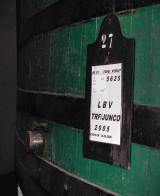
Ruby ports (Ruby, Ruby Reserva, LBV & Vintage) all tend to be stored in large wooden vats until bottling. This is to minimise the exposure to wood and oxygen.
Tawny ports, including standard, aged tawny and colheita are aged in small vats and/or pipes in order to provide greater wood contact and oxidation.
Derek
"The first duty of Port is to be red" Ernest H. Cockburn
A tricky question to try and answer 100% correctly, as there isn't one correct answer. More like just "guidelines."
All Port starts out in a large wood barrel, concrete container, or metal vat. At some point it may be transferred to a smaller container of wood or metal.
Eventually, if its destined to be a tawny Port it will most likely spend some time in a small pipe. But that varies based on producer and a number of other factors. And it may never see the inside of a small pipe.
Ruby Ports generally aren't placed in small pipes, although there are some exceptions. Typically they're housed in larger wooden or metal containers until bottled.
ac-fast wrote:How many years in barrel before botteling.
I don’t think there’s any regulation for minimum time in the barrel for ruby Ports, although many shippers seem to self-impose one. I think basic tawnies (i.e. not with an indication of age) need to be at least 6 years old and colheitas, 7.
One thing that I have been wondering about for a while is that you sometimes hear it said at tastings of cheaper Ports that some houses blend red and white Ports for their basic tawnies to artificially increase their apparent age. On questioning, no-one will come out with details of which shippers actually does this. Does anyone know if this does take place?
ac-fast wrote:So the differents is the aging.
I could`nt find anything about Reserva ports
I think there is also a subjective element here, too. The difference between a Ruby Reserve and a normal Ruby Port is that the Reserve is simply supposed to taste like a Reserve Port. I imagine a final blend for a basic Tawny Port must also taste like a tawny Port and that is as important as how the wine aged.
I would say, don't worry too much about the method with these classes of port; but compare the results..
Without naming names, one of the top selling UK ruby reserves does not show terribly well against the standard ruby from the same house; and the standard and reserve tawny market is hugely diverse, with the standard products of some producers seeming to outgun the reserves of others..
Marketing costs are not insignificant at the volume end of the market - products that have little or no promotional cash behind them can often afford good value as a result..
Tom
I may be drunk, Miss, but in the morning I shall be sober and you will still be ugly - W.S. Churchill
 )
)