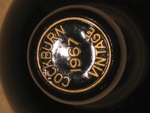
Late Bottled Vintage
I recently acquired a copy of Geoffrey Murat Tait's ‟Practical Handbook on Port Wine”, published in 1925.
GMT was member of the port trade and, I believe, was related to the shipper Stormonth Tait & Co. and, from an earlier period, Velloso & Tait and Noble & Murat. Certainly, in his books, he introduces himself as being from Oporto.
GMT's books (‟Practical handbook on Port Wine” and ‟Port - From the Vine to the Glass”) are must-haves for port enthusiasts. But, unfortunately, there are very few copies available and, those that are, are expensive.
So, having read both of these small volumes, I thought it would be interesting to quote the following, very early, description of ‟Late Bottled Vintage Port” !
What GMT describes as LBV is, in today's terminology, a cross between LBV and Colheita. I find it interesting that at a time before the modern definition of LBV arose this style of wine was one of only two styles that merited a place in this book, the other being Vintage Port.
I think this book is an interesting insight into the trade in that period.
Derek
GMT was member of the port trade and, I believe, was related to the shipper Stormonth Tait & Co. and, from an earlier period, Velloso & Tait and Noble & Murat. Certainly, in his books, he introduces himself as being from Oporto.
GMT's books (‟Practical handbook on Port Wine” and ‟Port - From the Vine to the Glass”) are must-haves for port enthusiasts. But, unfortunately, there are very few copies available and, those that are, are expensive.
So, having read both of these small volumes, I thought it would be interesting to quote the following, very early, description of ‟Late Bottled Vintage Port” !
What GMT describes as LBV is, in today's terminology, a cross between LBV and Colheita. I find it interesting that at a time before the modern definition of LBV arose this style of wine was one of only two styles that merited a place in this book, the other being Vintage Port.
I think this book is an interesting insight into the trade in that period.
Derek
"The first duty of Port is to be red"
Ernest H. Cockburn
Ernest H. Cockburn
Re: Late Bottled Vintage
Fascinating stuff.
In this thread
But does this force a reassessment of the debate re: earliest commercially released "late bottled vintage"?
In this thread
And I seem to recall there are a few who contend that the earliest is a Ramos 1927 or somesuch.DRT wrote:I have a bottle of Taylor LBV 1965. This was the first LBV to be produced on a commercial basis. It is hereby donated to this off-line.
But does this force a reassessment of the debate re: earliest commercially released "late bottled vintage"?
Rob C.
Re: Late Bottled Vintage
Yes - although a 1916 bottled in 1922 could conceivably come under the modern definition of an lbv? (in particular, if the mention of keeping "stock" in the last paragraph implies that 1916 juice (rather than that of different vintages) was used to refresh).DRT wrote:What GMT describes as LBV is, in today's terminology, a cross between LBV and Colheita.
Rob C.
Re: Late Bottled Vintage
Perhaps. But it is not clear from this book who it is that is creating this "style".RAYC wrote:But does this force a reassessment of the debate re: earliest commercially released "late bottled vintage"?
Back then almost all port was shipped in pipes and bottled by the wine merchants, so he might be referring to a practice that was decided upon by the wine merchants in order to accelerate the aging of the wines rather than a specific product being sold by the shippers. I think this is where the Taylor 1965 probably does have a rightful claim as the first "commercial" LBV, in that the wine was specifically intended to be this style and was bottled and sold by the shipper as such. Other shippers did experiment with bottling their own LBVs, including Noval and Ramos-Pinto, but I think Taylor were the first to do it seriously for a wide market.
As to the LBVs described by Tait in 1925, we might never know whether this was something being driven by the shippers or the wine merchants. But what is clear, is that the style is much older than we might previously have thought.
It is also interesting that at that time there seems to have been no distinction whatsoever between LBV and Colheita. The two examples given would today be classed as a Colheita (v1908, b1920) and an LBV (v1916, b1922), but in Tait's world they were classed as the same style of wine.
Does anyone know when Colheita became a specific classification/style?
Derek
"The first duty of Port is to be red"
Ernest H. Cockburn
Ernest H. Cockburn
- JacobH
- Quinta do Vesuvio 1994
- Posts: 3300
- Joined: 15:37 Sat 03 May 2008
- Location: London, UK
- Contact:
Re: Late Bottled Vintage
Derek, thanks for posting this excerpt. What I find very interesting is the length of time he states a LBV matures in wood. One change over the last Century in Port production seems to be a general reduction in the wood-maturing period of Ports. With the exception of Niepoort’s Pisca, I think all Vintage Port is now bottled two years after harvest, whilst, in the past, three years in wood was common. LBV is also never matured for 8 to 12 years. Most producers seem only to mature their LBVs for the bare minimum of four years, too.
With regards to colheitas, I notice he goes on to say:
I’d be interested in the answer to Derek’s question, too.
I think what Tait is describing is a shipper-made product. I think Late Bottled Vintage Port that was bottled late due to it sitting around a merchant’s cellar for a few years before bottling would be quite a different product, not least because I don’t suppose the merchants never topped up their barrels.DRT wrote:As to the LBVs described by Tait in 1925, we might never know whether this was something being driven by the shippers or the wine merchants. But what is clear, is that the style is much older than we might previously have thought.
Reading through that, I get the impression that all of these are what we would call ‟colheitas” today. Even the 1916s bottled in 1922 could begin to go a tawny colour in that time since they have had only one year less in wood than a modern colheita is required to have. Niepoort’s colheitas are a good testament to that style (very short-matured colheitas) working and I think this is backed up by what Rupert Croft-Cooke wrote in his book in 1957:DRT wrote:It is also interesting that at that time there seems to have been no distinction whatsoever between LBV and Colheita. The two examples given would today be classed as a Colheita (v1908, b1920) and an LBV (v1916, b1922), but in Tait's world they were classed as the same style of wine.
Does anyone know when Colheita became a specific classification/style?
The mention of lighter colour and body and tawniness suggest something a bit more like an colheita (or half-way between a colheita and a vintage port), to me, especially since he goes to great length to explain why a Crusted Port can imitate a Vintage Port which you would have thought would also be the case for an LBV if it were to be made in either of the modern styles.Rupert Croft-Cooke wrote:After Vintage Port proper there are several minor variations. Late Bottled Vintage is the first among them, indeed is held by Geoffrey Tait to combine the best qualities of Vintage and Tawny Ports. It was formerly made more than it is today.
A fine vintage wine is kept in cask longer than the accepted period of two year, then in bottle for a further period. When it has been in the wood no more than three years it will be only slightly tawnier in colour than a Vintage Port, but when, as sometimes happens, it has been five years or more in cask it will be a lighter wine altogether in colour and body. It will take less time in bottle to come to its best.
With regards to colheitas, I notice he goes on to say:
It appears the word ‟colheita” is never used.Shippers are often asked why they do not sell a ‟Vintage Tawny”. It is a contradiction in terms. A Tawny may have started as a Vitnage wine, but so many will have been the additions if it is to reach perfection as a Tawny that it would not be honest to use any specific year as its own.
I’d be interested in the answer to Derek’s question, too.
Re: Late Bottled Vintage
RAYC wrote:Fascinating stuff.
In this threadAnd I seem to recall there are a few who contend that the earliest is a Ramos 1927 or somesuch.DRT wrote:I have a bottle of Taylor LBV 1965. This was the first LBV to be produced on a commercial basis. It is hereby donated to this off-line.
But does this force a reassessment of the debate re: earliest commercially released "late bottled vintage"?
as I recalled this thread
I spotted a Warres 1961 LBV.
http://www.brentwoodwine.com/os/itemhtml/ht614066.shtml
Disclosure: Distributor of Quevedo wines and Quinta do Gomariz
Re: Late Bottled Vintage
And I got pictures and they look legit with proper selos on them
What determines first lbv to be produced on commercial basis?
for those curious
selos are
990818
990837
990842
What determines first lbv to be produced on commercial basis?
for those curious
selos are
990818
990837
990842
Disclosure: Distributor of Quevedo wines and Quinta do Gomariz
Re: Late Bottled Vintage
It's whatever the marketing men want it to mean.g-man wrote:What determines first lbv to be produced on commercial basis?
Lots of port shippers experimented with LBV prior to it becoming an official style. It all seems to have started with UK bottlers keeping the wines in wood until they were sold. This meant that some VP was being bottled 4, 5 or more years after the vintage. Many very old price lists (19th to early 20th century) have wines listed as "Late Bottled" or "Lately Bottled", but at that point it wasn't a "style" that the port shippers were making. It was really just VP that was bottled later than intended.
In the early 20th century the experiments started and small amounts of wine were bottled at 4 or 5 years after the vintage and sold as Late Bottled Vintage, like the Dow 1961 was. But I don't think this was a recognised style at that time and it would have been in very short supply. I believe Cockburn made an attempt to launch a "commercial" LBV and were halted in their tracks due to complaints from a certain shipper who said that the style would ruin the Port trade. A few years later that same shipper sold a significant amount of 1965 LBV and the rest, as they say, is history!
A key fact that I do not know is when LBV became a recognised premium style of Port. Does anyone know?
"The first duty of Port is to be red"
Ernest H. Cockburn
Ernest H. Cockburn
Re: Late Bottled Vintage
ah so these 61's
are they in essence colheitas?
was 61 even a good vintage?
are they in essence colheitas?
was 61 even a good vintage?
Disclosure: Distributor of Quevedo wines and Quinta do Gomariz
Re: Late Bottled Vintage
I have no idea how you deduced that from what I said. No, they are not Colheitas, they are Late Bottled Vintage.g-man wrote:ah so these 61's
are they in essence colheitas?
1961 was not a good vintage, but I (and AHB) have had the 1961 Dow LBV at this tasting and it was surprisingly good.
"The first duty of Port is to be red"
Ernest H. Cockburn
Ernest H. Cockburn
- Alex Bridgeman
- Croft 1945
- Posts: 16454
- Joined: 12:41 Mon 25 Jun 2007
- Location: Berkshire, UK
Re: Late Bottled Vintage
I have a bottle of Dow 1962 LBV that I plan to open at some point this year.
I have the impression that LBVs from the early (as opposed to mid) sixties were not necessarily made with the intention of them being light and early maturing wines that showed little improvment in the bottle. I do recall being quite impressed by the Dow 1961 LBV and thoroughly enjoying it with a steak. It was sweet and mature, and certainly very tawny - but also something that I thoroughly enjoyed and encouraged me to buy the 1962 LBV in the hope that this will be just as good.
Top 2025: Quevedo 1972 Colheita, b.2024. Just as good as Niepoort 1900!
2026: DR Very Old White, Graham Stone Terraces 2011, Quevedo Branco 1986 b.2026
- uncle tom
- Dalva Golden White Colheita 1952
- Posts: 3574
- Joined: 22:43 Wed 20 Jun 2007
- Location: Near Saffron Walden, England
Re: Late Bottled Vintage
My oldest bottle of LBV is a Martinez 1955, English bottled in 1964 by Robert James & Son Co. Ltd
I also have LBVs from 1960 and 1961
It would seem that 1964 was the year the term 'Late bottled vintage' first appeared on retail stocks
I also have LBVs from 1960 and 1961
It would seem that 1964 was the year the term 'Late bottled vintage' first appeared on retail stocks
I may be drunk, Miss, but in the morning I shall be sober and you will still be ugly - W.S. Churchill
Re: Late Bottled Vintage
The term was in use before then, Tom!uncle tom wrote:It would seem that 1964 was the year the term 'Late bottled vintage' first appeared on retail stocks
The above are from the minutes of the Wine Committee of the Union Club in 1961, and clearly suggest that Christopher & Co had "Late Bottled Vintage" on their list of wines for sale. But, like the example given by Tom, these would have been shipped as VP and then bottled late by the UK merchant. That isn't a "commercially produced" LBV, in my view. It is something that the merchant decided to do, probably to the annoyance of the shipper.
I am sure I have seen other, much older, references and if I find some I will post them here.
I don't think the appearance of the term on price lists is the key to the point where LBV was "commercially produced". I think the reasonable answer to that is the point at which the shippers started producing and shipping LBV in large quantities and in the "ready to drink" style we know. Although there is plenty of evidence to demonstrate that many shippers dabbled in producing and shipping LBV, there is little or no real evidence to counter Taylor Fladgate's claim to have been the first shipper to fully commercialise the style with the Taylor 1965 that was bottled and shipped in 1969.
"The first duty of Port is to be red"
Ernest H. Cockburn
Ernest H. Cockburn
- uncle tom
- Dalva Golden White Colheita 1952
- Posts: 3574
- Joined: 22:43 Wed 20 Jun 2007
- Location: Near Saffron Walden, England
Re: Late Bottled Vintage
My Dow 1960 LBV's were Oporto bottled in 1965 and clearly labelled as such - Taylor's claim doesn't hold up.there is little or no real evidence to counter Taylor Fladgate's claim to have been the first shipper to fully commercialise the style with the Taylor 1965 that was bottled and shipped in 1969.
I may be drunk, Miss, but in the morning I shall be sober and you will still be ugly - W.S. Churchill
Re: Late Bottled Vintage
That is true, but only if you remove the context by only quoting the part that works for your argument. What I said was...uncle tom wrote:My Dow 1960 LBV's were Oporto bottled in 1965 and clearly labelled as such - Taylor's claim doesn't hold up.there is little or no real evidence to counter Taylor Fladgate's claim to have been the first shipper to fully commercialise the style with the Taylor 1965 that was bottled and shipped in 1969.
The first part allows for your Dow 1960. The second part invites contradiction of evidence of fully commercialised production of shipping, but there is none. Believe me, I have looked! A telling point is that until a couple of years ago Taylor were claiming to have invented the style, which was a major irritation to the other shippers, as well as being completely untrue. However, the marketing blurb doesn't say that any more and they now stake the claim to have been the first to fully commercialise the style. It is significant that no shipper has challenged that. In fact, I know some who confirm it to be true.DRT wrote:Although there is plenty of evidence to demonstrate that many shippers dabbled in producing and shipping LBV, there is little or no real evidence to counter Taylor Fladgate's claim to have been the first shipper to fully commercialise the style with the Taylor 1965 that was bottled and shipped in 1969.
"The first duty of Port is to be red"
Ernest H. Cockburn
Ernest H. Cockburn
- uncle tom
- Dalva Golden White Colheita 1952
- Posts: 3574
- Joined: 22:43 Wed 20 Jun 2007
- Location: Near Saffron Walden, England
Re: Late Bottled Vintage
One could argue till the cows come home about what is meant by 'fully commercialise..'
Taylor may well have been the first to filter their LBVs, and possibly the first to market it with a T stopper; but that's probably the limit of the definable 'firsts' they can claim, other than, perhaps, the first to sell a million bottles..
I may be drunk, Miss, but in the morning I shall be sober and you will still be ugly - W.S. Churchill
Re: Late Bottled Vintage
It seems that we are now agreeing 
"The first duty of Port is to be red"
Ernest H. Cockburn
Ernest H. Cockburn
Re: Late Bottled Vintage
Another claim for the first LBV!!
This time by Noval:
Anyway, the back story to Noval's claim, in pidgeon English courtesy of babelfish and indicating that this was indeed intended as a true "ready to drink" style bottled in Oporto prior to being shipped, is as follows:
nb - related post here
This time by Noval:
We really are into meaningless semantics if Ramos Pinto have the oldest "registered" LBV, Noval "launched" the first LBV, and Taylor first "commercially produced" / released "fined and filtered" LBV, particularly when there is evidence of "late bottled vintage" being sold as such to consumers by merchants for many years before then.[url=http://www.quintadonoval.com/articles-l.histoire-135]Here[/url], Noval wrote:Noval has created a totally new category of Port: the Late Bottled Vintage.
In 1958 Quinta do Noval was the first house to launch a 'Late Bottled Vintage' Port, with its 1954 LBV. This implied the creation of a whole new category of Port wine which was at the heart of discussions in the region for many years.
Always a pioneer, Quinta do Noval continues to show the way today with its exclusive unfiltered Single Quinta LBV, made entirely from grapes from our Quinta, foot trodden in lagares, as for our Vintage Ports.
Anyway, the back story to Noval's claim, in pidgeon English courtesy of babelfish and indicating that this was indeed intended as a true "ready to drink" style bottled in Oporto prior to being shipped, is as follows:
So perhaps Rutherford, director of the company that was then Noval's agent in England, deserves a bit of credit! Adding credence to the Noval claim is that IVP first recognised "Late Bottled Vintage" as a distinct category in 1958...would be interesting to know if the two events were related. If Noval/Rutherford were behind the creation of the designation in any major way, i am inclined to give them the nod! Particularly if Noval 1958 was the first LBV actually registered with IVP.[url=http://www.diprimsa.es/noval/LVB.php]Here[/url], someone wrote:At the beginning of 1940, Colonel Jack Rutherford, Chief of a main directorate of the wine retailer Rutherford, Osbone & Perkin, in England, began leaving the rest of the wine pipe of Oporto Vintage in a barrel by a pair of years more of the usual thing. To the Colonel and Mrs. Rutherford they liked to share average wine bottle of Oporto Vintage every night, a habit who found difficult to maintain in time military. On the other hand, the bottled wines of Oporto after four years in barrel could be drunk almost immediately, without years of aging in bottle. In 1958, Colonel Rutherford and Mr. Vasconcelos Porto decided to send the first one of wine of Oporto delayed bottled: 1954 Villa do Noval LBV. This one was the beginning of a new wine category of Oporto.
nb - related post here
Last edited by RAYC on 02:13 Tue 28 Feb 2012, edited 8 times in total.
Rob C.
-
Glenn E.
- Cálem Quinta da Foz 1970
- Posts: 4513
- Joined: 21:27 Wed 09 Jul 2008
- Location: Seattle, WA, USA
Re: Late Bottled Vintage
It seems to me that Noval's claim is trumped by Ramos Pinto's, but that Taylor's claim and Ramos Pinto's claim can co-exist.
Glenn Elliott
Re: Late Bottled Vintage
Despite the fact that the Ramos Pinto LBV was not registered with IVP until 1986...?!Glenn E. wrote:It seems to me that Noval's claim is trumped by Ramos Pinto's, but that Taylor's claim and Ramos Pinto's claim can co-exist.
Whereas the Noval 1954 LBV appears to have been advertised in the Spectator and "commercially available" in 1961, according to a tantalising snippet on Google Books (which also makes reference to an Offley 55 LBV). Anyone have access to old issues of the Spectator?
Rob C.
-
Glenn E.
- Cálem Quinta da Foz 1970
- Posts: 4513
- Joined: 21:27 Wed 09 Jul 2008
- Location: Seattle, WA, USA
Re: Late Bottled Vintage
While at Quinta da Ervamoira in 2010, we were told by Joao Nicolau de Almeida that Ramos Pinto registered an LBV with the IVP in the 1930s. I don't remember the exact date of the Port or the registration.RAYC wrote:Despite the fact that the Ramos Pinto LBV was not registered with IVP until 1986...?!Glenn E. wrote:It seems to me that Noval's claim is trumped by Ramos Pinto's, but that Taylor's claim and Ramos Pinto's claim can co-exist.
It's possible that he told us they had the oldest registered LBV and left out that, while being bottled in the 1930s, it wasn't registered until 1986.
Glenn Elliott
-
Glenn E.
- Cálem Quinta da Foz 1970
- Posts: 4513
- Joined: 21:27 Wed 09 Jul 2008
- Location: Seattle, WA, USA
Re: Late Bottled Vintage
Aha! It is, in fact, the latter. The 1927 Ramos Pinto LBV is the oldest registered LBV. Said registration took place in 1986.
Glenn Elliott